


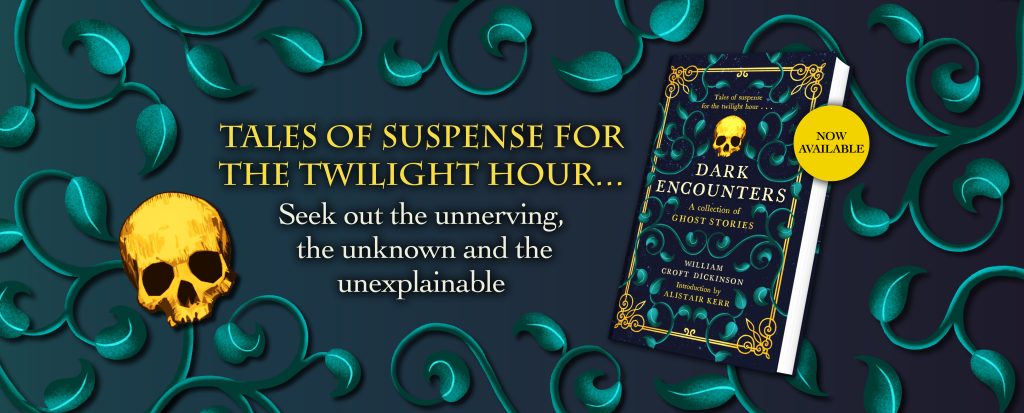
Edited by Alistair Kerr, Dark Encounters is a collection of classic and elegantly unsettling ghost stories first published in 1963. A spine-tingling collection, these tales are set in the brooding landscape of Scotland, with an air of historic authenticity – often referring to real events, objects and people. This extract is from the story, ‘The Witch’s Bone’.
Michael Elliott, M.A., LL.D., F.S.A. (SCOT.), frowned at the letter which had come from the Honorary Curator of the local Museum. It was quite a short letter and quite a simple one: merely asking him if he would allow the Museum to borrow his ‘Witch’s Bone’ for a special exhibition covering Folk Beliefs and Customs. But Michael Elliott found the letter far from welcome. Short and simple as it was, it revived and increased all the fearful troubles of his mind. More than that, dare he now let the ‘Bone’ pass out of his own keeping – even if only for a little while?
Every day, for the last week, that witch’s bone had preoccupied his mind to the exclusion of all else. The witch’s bone that had brought to an end all his quarrels with Mackenzie Grant. The witch’s bone that had possibly given him a revenge far more terrible than anything he had sought or expected. In a fit of anger he had thought only of testing its efficacy, never really believing it would work. And now he knew that the bone had worked only too well. Or had it? Had he indeed compassed Grant’s death? All he knew was that Grant had died and that now he found it hard to recover his peace of mind.
Of course, he had only himself to blame. He had shown the bone at the last meeting of their local Antiquarian Society, just Darkafter he had acquired it; and, pleased with himself, he had expatiated upon its awful power. Mackenzie Grant had contradicted him – as usual. Grant had always treated his theories with contempt. There was his paper on lake-dwellings, and, after that, his paper on the iron-age forts in the Central Highlands. Upon both occasions Grant had stood up and poohpoohed everything he had said. At meetings of the Council, too, the man could be relied upon to speak against anything he proposed. But all that was past history. Grant had poured scorn upon his story of the bone. And now Grant was dead. Yet how unbounded would be the relief to his tortured mind if Grant had been right, and if the story of the bone were ‘stuff and nonsense’ and nothing more. The very night that Grant had ridiculed his story he had put the bone to the test, directing its malevolent powers against Mackenzie Grant. And Grant had died a horrible death a few hours later. But could it not have been a ghastly coincidence in which the bone had played no part at all?
It was only a short piece of bone – probably sheep-bone – about six inches long, with a narrow ring of black bog-oak tightly encircling it near its centre. He had acquired it during his recent holiday in Sutherland. An old woman had died in a remote glen, and, because she had been reputed to be a witch, and had been feared as such, no one would bear her to burial. The local minister had called upon him, beseeching his help. ‘The poor body was no witch at all,’ the minister had said. ‘She was just old and ill-favoured. I have had a coffin made of about the right size – at any rate it will be large enough – and if you could just drive me to the old body’s hut, with the coffin in the rear of your estate-wagon, maybe we could manage to coffin her and give her a Christian burial.’
A strange request to make of any man! But the minister had won him over, and his reward had been the witch’s bone.
They had found it on a shelf in the old woman’s hut. The minister had seen it first, and had prodded it gently with his finger. ‘So,’ he had said softly. ‘The witch’s bone. I have been told of it. There are those of my people who say that she would utter her curse upon some man or woman, and then would make a wax figure and stick a pin into it. Then they say that if this bone rattled on its shelf, she knew that her curse had taken effect and that the person portrayed in the wax would be seized with pains in that part of the body which corresponded with the place of the pin in the wax. Some have even said that she could kill by sticking her pin in the heart or the head. For the power is in the bone. It can wound or kill any who are cursed by its possessor. And never are they spared.’
He had listened and looked with astonishment until, suddenly, the minister’s face had changed and he had cried out: ‘But what am I saying to you? There is no Witch of Endor in Sutherland. Indeed there is not. No such devilry is possible. I am not believing one word of it.’ And the minister had boldly picked up the bone and had offered it to him. ‘Take it with you,’ he had said. ‘It may interest some of your friends in the south.’
And, wondering, he had taken it.
William Croft Dickinson, CBE (28 August 1897 – May 1963) was an English historian, a leading expert in the history of early modern Scotland and an author of both children’s fiction and adult ghost stories.
Alistair W. J. Kerr was born in Scotland. His father was an officer in the Royal Army Medical Corps, who later became an academic. Alistair studied History and Law at the University of Edinburgh and later became a civil servant. He is the author of Betrayal: The Murder of Robert Nairac GC (Cambridge Academic, 2015).


